



FAQ Locksmith Answers
1. What qualities and attributes make a good locksmith company?
There are many factors that go into making a good locksmith company and everyone will have their own opinion on this issue. Below, I am going to outline a few the things that we think make a good locksmith company.
1. The company you select needs to have firm roots in Atlanta. When I refer to having roots in Atlanta what I am saying is that you should look for a company that has a successful track record of serving customers in Atlanta for many years. Why risk your company's security by using an unproven vendor with no references?
2. Look for a security company that has the size to adequately service your properties. For commercial clients this means having multiple service vehicles (5+ trucks). Due to a lack of regulation for locksmiths in Georgia, 99% of locksmith companies do not meet this requirement. It should not take a week for a technician to come out and see you. If you find yourself waiting more than 24 hours for a service visit you need to look for a new provider.
3. Make sure your locksmith carries insurance. If any locksmith will not readily provide you with a copy of their insurance you should not let them do work on your property. Make sure to protect yourself and your business. Any reputable locksmith will carry a multi-million dollar General Liability & Workmen's Compensation Insurance Policy and will give you a copy if requested.
4. All reputable locksmiths will have an office location in Atlanta. We can not stress this point enough. Through the years we have seen many "mobile" and out of state locksmiths do unjustice to the profession. You need to ensure you are dealing with a professional company and not just a single or fly by night entity.
5. Last but not least, work with someone you trust. Someone who will take the time to learn your property and your particular needs. Every property and every customer is different, your security provider should take the time to learn how you do business.
2. What should the average consumer know about the locksmith industry in Georgia?
What most people do not know and what a lot of locksmiths will not tell you is that the locksmith industry in Georgia is completely unregulated. Mobile shops spring up daily with no insurance, no shop location, and very little experience. It is really important to choose a locksmith who has a proven track record and does not mind taking the time to speak with you or answer your questions. When you see -Mobile Service- you should be cautious. You want to deal with a company that has roots in a community and has been there a long time with an established shop location.
At Armor, we favor regulation and have been lobbying for many years to establish it. Calendar year 2009 HB 107 addresses the licensing of locksmiths and we encourage everyone to contact their representatives and ask them to support this bill. A big thank you is due to Harry Geisinger, Jill Chambers and Barbara Sims for their support of this bill. Contact the representatives in your district and ask them to support this as well. As important as regulation is it will be just as important to ensure it's enforcement.
Armor has created a Locksmith Licensing & Regulation per State Infographic to help you see which states are serious about protecting their citizens from bad vendors.
It has amazed us for years that you have to be licensed in Georgia to cut hair but not to do locksmith work. Hopefully that will change.
3. What makes Armor Lock & Security different?
There are many factors that make Armor Lock & Security different from the competition. A few are:
1. Armor's knowledge of the Atlanta market place is second to none. We have been working as a commercial locksmith in Atlanta for over 45 years. We have seen and been apart of the changes and growth in Atlanta and through this we have gained valuable insight into the security needs of our customers and our markets.
2. Armor's Staff and Technicians are the best! Our technicians have been with us on average 20+ years. We have a cumulative total of over 250 years experience between our service technicians. That is experience which will better help us serve our customers needs.
3. Armor's size allows us to serve our market better. We have many service trucks throughout Atlanta each day and because of this we are able to give our customers great service. We never make you wait more than 24 hours for a site visit, over 99% of the time we can see you same day.
4. Armor carries the proper insurance and licenses to serve you.
5. Armor takes an interest in our customers, stated simply "We care". Our repeat customers know us by name and we know them. In addition, we know their properties and operating procedures. We take the time to understand our customers and their needs because we intend on keeping them as clients.
4. What areas does Armor serve?
Armor Lock & Security serves all of metro Atlanta. If you have any specific questions just give us a call at 770-493-1915.
5. What markets does Armor serve?
Armor serves the commercial, industrial and residential markets. We do everything except automobiles.
6. Does Armor give appointments?
Only for the first job of the day, otherwise we can call you when we are on our way. We can also hit time frames but giving an exact appointment in the afternoon can be challenging. If you absolutely require a certain time give us a call and we will try to work something out with you.
7. Does Armor carry insurance?
Of coarse, and we are happy to send you a copy prior to doing work for you. If someone will not do this you should not do business with them.
8. Does Armor carry a low voltage license?
Yes we do, and we are perfectly fine with you asking to see it before we service your property.
9. Is it possible to get the approximate cost for a specific locksmith or security task?
Certainly, just give us a call at 770-493-1915 or email us and we can usually give you a ballpark price over the phone. For large jobs we will send a technician by for a free estimate.
10. What is a master key system and why is key control important?
Great questions and we have devoted a complete page to all information regarding master key systems.
11. How do you select the function of a lockset?
Another great question, we've dedicated a complete page to locksets and their lockset functions.
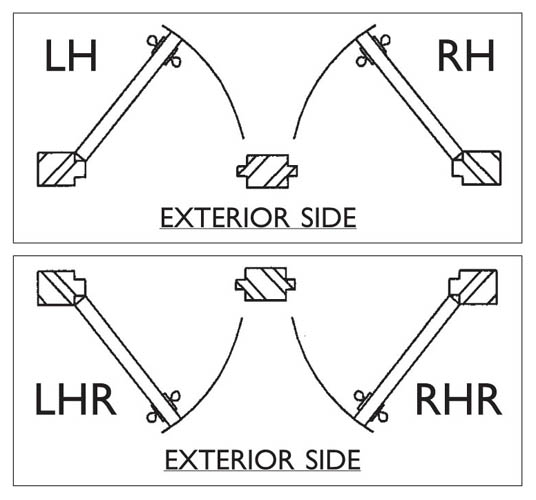
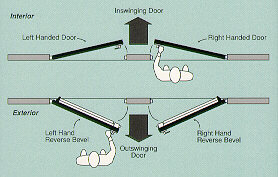
12. How do you determine the handing of your hardware?
"Hand of door" indicates the direction of the swing of the door. It is always viewed from outside the room, building, etc.
LH = Left Hand
RH = Right Hand
LHR = Left Hand Reverse
RHR = Right Hand Reverse
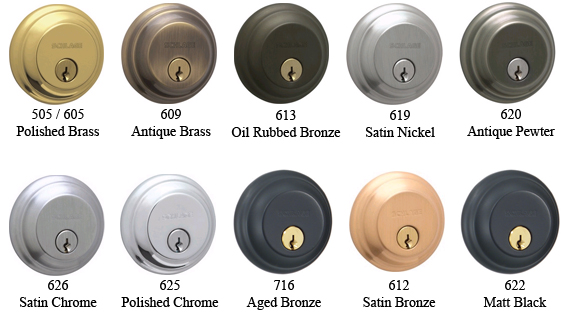
13. What is the color of my hardware?
14. What is lock bumping? How do you protect against it?
Lock bumping may have originated in Denmark in the 1950s, but this is far from clear. It may have started independently in several places. A Dutch TV show explaining the technique was broadcast in April 2005 and found its way to internet video sites in 2006, popularizing the technique considerably. Please see the Associated Locksmith's of America official stand on lock bumping (click here).
Essentially, it is a way of modifying an existing key so that it is able to manipulate and open locks through a technique known as bumping. There is a lot of hype regarding this techinique at the moment. It's important to note that concern over this is probably undue for residential security. Thiefs are much more likely to just break a window.
Armor does recognize that security is a matter of personal feeling though. If you do have cause for concern, here are two ways to protect yourself from lock bumping. One is to install high security locks, Armor Lock & Security recommends ASSA Locks. A second way is to go with an electronic lockset or access control system. If you have any specific questions please contact us and we would be happy to help you with a security audit.